2018 Toyota Tacoma: Solid

Owners filed 146 complaints with NHTSA about the 2018 Toyota Tacoma in its first five years on the road, about 63 for every 100,000 sold: 0.9× the rate of a typical Tacoma year. That's close to a typical year.

The biggest problem area, counting serious complaints more, is the fuel or propulsion system (39% of complaints, median 23,000 miles).

Complaint index
0.9×
per vehicle sold, vs. a typical Tacoma year
Rank
6th of 14
1st = fewest complaints
Complaints
146
first five years; 63 per 100,000 sold
Recalls
3
campaigns
3rd generation, 2016–2023 · Updated September 24, 2026 · How we rate
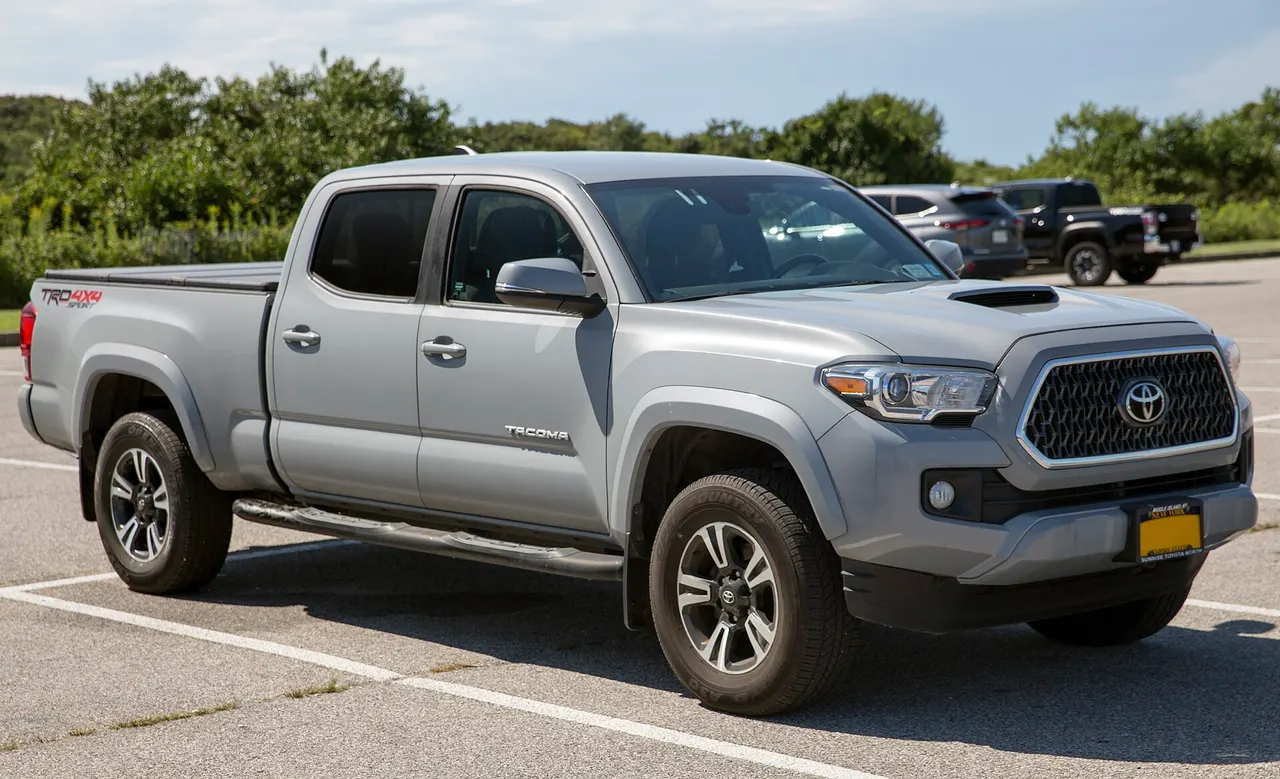
2019 Toyota Tacoma TRD Sport Double Cab

Photo: 2019 Toyota Tacoma TRD Sport Double Cab · Mr.choppers, CC BY-SA 3.0, via Wikimedia Commons

Problem areas

Ranked by severity-weighted complaints · share · median miles
  1. Fuel and propulsion39% · 57 complaints · median 23,000 miles
  2. Brakes18% · 27 complaints · median 9,000 miles
  3. Powertrain17% · 25 complaints · median 6,000 miles
  4. Engine14% · 20 complaints · median 15,000 miles
  5. Speed control12% · 18 complaints · median 5,000 miles
  6. Electrical5% · 8 complaints · median 22,000 miles
  7. Driver assistance3% · 5 complaints
  8. Air bags1% · 2 complaints
  9. Steering3% · 4 complaints
  10. Suspension3% · 4 complaints

Bars rank problem areas by complaints weighted for severity (crashes, fires, injuries and deaths count more). A complaint can name more than one area. Mileage is reported on about half of complaints.

What owners describe

Brakes

Owners of this Tacoma report braking problems ranging from a soft pedal to brake fluid leaking into the cab, sometimes tied to the master cylinder or brake booster. Repairs vary, with some getting parts replaced and others told their truck isn't covered by a related recall.

Warning signs:
Many report a soft or spongy pedal, fluid dripping onto the floor mat or pedal, and some note vibration or shuddering when braking.
What shops did:
Dealers most often replaced brake pads, rotors, drums, the master cylinder, or brake booster, though some owners say the shop could not duplicate the issue or said the part wasn't covered.
Mileage:
most between 5,000 and 20,000 miles, among 24 complaints that give it

“the brake pedal was spongy while depressed”

“Brake pedal went to the floor and I lost almost all braking, had to use the hand brake to get home.”

Fuel and propulsion

Owners describe stalling or rough running tied to the fuel pump, often preceded by warning lights or hesitation while driving. Many faced long waits for recall parts, and a few say problems continued even after the recall repair.

Warning signs:
Many report warning lights (check engine, low fuel pressure), rough idling, shaking, misfiring, hesitation, or sudden loss of power before stalling.
What shops did:
Many owners say the recall part was unavailable for months; some had the fuel pump replaced but a few still experienced stalling afterward, and some dealers could not replicate or diagnose the issue.
Mileage:
most between 10,000 and 35,000 miles, among 25 complaints that give it

“The truck runs rough most of the time and I have problems with it stalling and not wanting to start back up again.”

“When driving, vehicle begins to lose acceleration and check engine light begins flashing.”

Powertrain

Owners of this Tacoma describe transmission and drivetrain behavior that feels jerky, hesitant, or unpredictable, particularly when accelerating from a stop or coasting at moderate speeds. Many say dealers were unable to reproduce or permanently fix the issue despite multiple visits and software updates.

Warning signs:
Many report hesitation or delay when pressing the accelerator, followed by jerking, shuddering, gear hunting, RPM surges, or a stall-like miss.
What shops did:
Dealers often could not duplicate the issue, called it normal vehicle characteristic, performed software reflashes, or replaced fuel pump/wiring under recall with no lasting change.
Mileage:
most between 5,000 and 15,000 miles, among 22 complaints that give it

“The transmission jerks/delays/staggers at speeds of mid-30's, mid-40's, and around 65 MPH”

“The vehicle stalls intermittently. It is as if the traction control system is cutting throttle input for 1-2 seconds”

Summaries are written with AI from the owner complaints shown on NHTSA's site and checked against them; quotes are word for word.

  • NHTSA 20V682000November 20201,525,742 vehicles

    Fuel system, gasoline: delivery: fuel pump

    Toyota Motor Engineering & Manufacturing (Toyota) is recalling certain 2018-2019 4Runner, 2019-2020 Avalon, 2019 Corolla Hatchback, 2017-2019 Highlander, 2018-2020 Camry, 2020 Corolla, 2018-2019 Land Cruiser, 2017-2020 Tacoma, 2019-2020 RAV4, 2019-2020 Sequoia, 2017-2020 Sienna, 2019-2020 Tundra, 2018-2020 Lexus ES350, 2017 Lexus GS200t, 2017-2019 Lexus GS350, 2019 Lexus GS300, 2018-2020 Lexus LC500h, 2019-2020 Lexus LS500, 2018-2019 Lexus GX460, 2017 Lexus IS200t, 2019 Lexus IS300, 2019 Lexus IS350, 2018-2020 Lexus LC500, 2018 Lexus LS500, 2019 Lexus LS500h, 2018-2019 Lexus LX570, 2017 Lexus RC200t, 2019 Lexus RC300, RC350, 2017 and 2019-2020 Lexus RX350, 2018-2020 RX350L, 2019 Lexus UX200, 2018-2019 Lexus NX300 vehicles. The low-pressure fuel pump inside the fuel tank may fail.

    Risk: If the fuel pump fails, the engine can stall while driving, increasing the risk of a crash.

    Fix: Toyota will notify owners, and dealers will replace the fuel pump assembly with an improved one, free of charge.

  • NHTSA 20V012000January 20201,830,752 vehicles

    Fuel system, gasoline: delivery: fuel pump

    Toyota Motor Engineering & Manufacturing (Toyota) recalled certain 2018-2019 4Runner, Highlander, Camry, Land Cruiser, Sequoia, Sienna, Tacoma and Tundra, and Lexus RC 300, RC 350, GS 350, GX 460, IS 300, LC 500, LS 500, LX 570, RX 350L, and 2019 Toyota Avalon and Corolla, and certain Lexus NX 300, and ES 350 vehicles on January 13, 2020. On March 4, 2020, Toyota expanded the recall to include certain 2014-2015 Toyota 4Runner and Land Cruiser, 2018 Avalon, Corolla, 2014 FJ Cruiser, 2017 Sienna and Lexus 2018 ES 350, 2018-2019 GS 300, 2013-2014 GS350, 2014-2015 GX 460, IS 350 and LX 570, 2014 IS F, 2018-2019 IS 350, LC 500H and LS 500H, 2013-2015 LS 460, 2015 NX 200T and RC350, 2017 RC 200T and RX 350. Toyota also removed the 2018-2019 Toyota 4Runner and Land Cruiser and 2018-2019 Lexus GX 460 and LX 570 and 2019 NX300 from inclusion in this recall. On March 19, 2020, Toyota expanded the recall to include 2015 Lexus GS350 vehicles. The low-pressure fuel pump inside the fuel tank may fail.

    Risk: If the fuel pump fails, the engine can stall while driving, increasing the risk of a crash.

    Fix: Toyota will notify owners, and dealers will replace the fuel pump, free of charge.

  • NHTSA 18V888000December 201844,121 vehicles

    Service brakes, hydraulic: foundation components: master cylinder

    Toyota Motor Engineering & Manufacturing (Toyota) is recalling certain 2018-2019 Toyota Tacoma vehicles. Improper machining of the brake master cylinder may result in internal damage of one of the seals, affecting brake performance.

    Risk: Reduced brake performance can lengthen the distance needed to stop the vehicle, increasing the risk of a crash.

    Fix: Toyota will notify owners, and dealers will replace the brake master cylinder, free of charge.

A recall only helps if the repair was done. Enter the vehicle's 17-character VIN on NHTSA's official recall lookup before you buy.
Service bulletins

Toyota sent NHTSA 294 service bulletins and other notices to dealers covering the 2018 Tacoma. These are repair instructions, not recalls. Warranty extensions and bulletins about its top problem areas:

  • 23TE08 · September 2024 · Warranty extensionToyota has received some reports of paint peeling along the exterior door window frames and front inner fenders under the hood on certain Tacoma vehicles with 040 Super White paint color.
  • TSB011219 · August 2023TSB: Some 2005 ?
  • 23TE01 Dealer Pa · April 2023DP: Although the high-pressure fuel pump is covered by Toyota?s New Vehicle Limited Warranty for 5 years or 60,000 miles (whichever comes first), we at Toyota care about the customers?
  • TSB000923 · February 2023TSB: Some 2014 ?
  • 23TE04 · February 2023DL: On December 20, 2022, a settlement of claims for certain low pressure fuel pumps was approved by the federal court.
  • T-SB-0115-22 · December 2022TSB: Some 2019 ?
  • T-SB-0124-20 Rev · November 2022TSB: Some 2016 ?
  • T-TT-0705-22 Rev · September 2022TT: If you see this condition, please create a TAS case and contact TAS for instruction prior to diagnosing or repairing of the vehicle.

All 2018 Tacoma bulletins on NHTSA ›

Questions owners ask

Is the 2018 Toyota Tacoma reliable?
Owners filed 146 complaints with NHTSA about the 2018 Toyota Tacoma in its first five years on the road, about 63 for every 100,000 sold: 0.9× the rate of a typical Tacoma year. That's close to a typical year. Ratings compare Tacoma years with each other using complaints filed with NHTSA; they don't measure every problem owners have.
What are the most common 2018 Tacoma problems?
Owners' complaints most often involve the fuel or propulsion system (39%), the brakes (18%) and the powertrain (transmission and drivetrain) (17%). A complaint can name more than one area.
Has the 2018 Toyota Tacoma been recalled?
Yes. NHTSA lists 3 recall campaigns for the 2018 Toyota Tacoma, the most recent in November 2020 (fuel system, gasoline). Enter the vehicle's VIN on NHTSA's recall lookup to see whether the repairs were done.

Sources

Owner complaints, recalls and manufacturer communications from NHTSA's public data files, as of September 24, 2026. Complaints are counted once each, over the model year's first 60 months on the road. UsedScore is not affiliated with NHTSA or Toyota. The 2018 Toyota Tacoma on NHTSA.gov · How we rate