2017 Honda Accord: Solid

Owners filed 275 complaints with NHTSA about the 2017 Honda Accord in its first five years on the road, about 84 for every 100,000 sold: 1.0× the rate of a typical Accord year. That's close to a typical year.

The biggest problem area, counting serious complaints more, is the electrical system (23% of complaints, median 27,000 miles).

Complaint index
1.0×
per vehicle sold, vs. a typical Accord year
Rank
7th of 14
1st = fewest complaints
Complaints
275
first five years; 84 per 100,000 sold
Recalls
3
campaigns
9th generation, 2013–2017 · Updated September 24, 2026 · How we rate
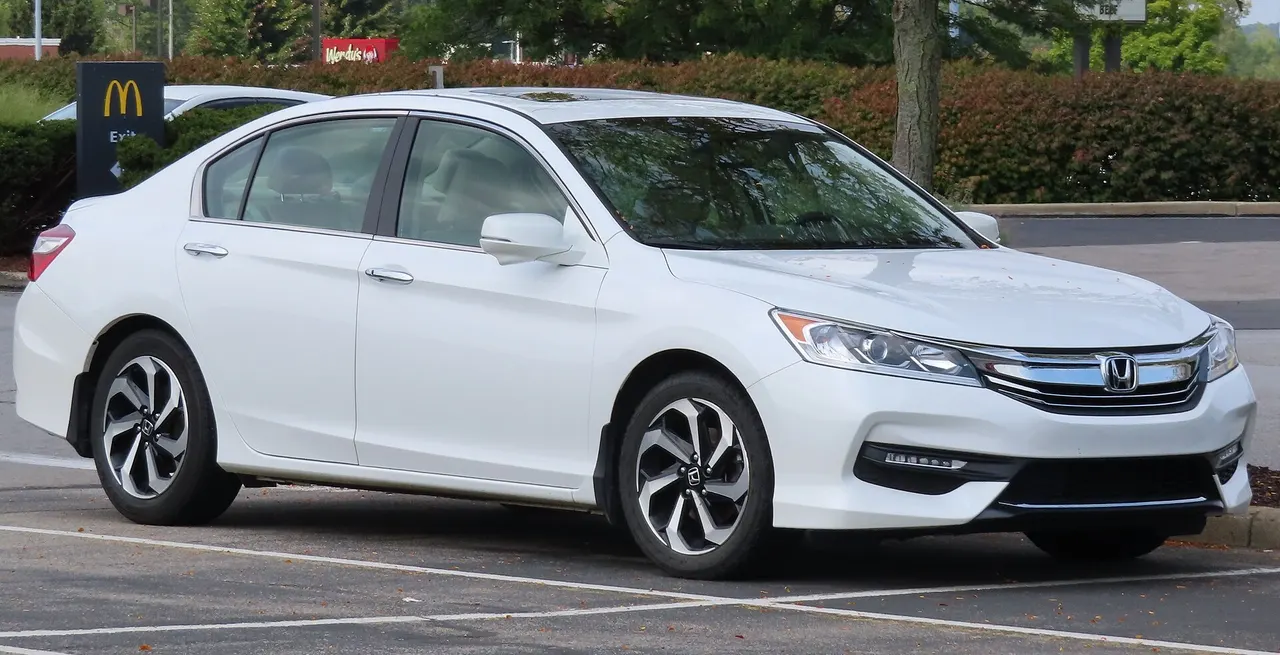
2016 Honda Accord EX-L sedan (facelift)

Photo: 2016 Honda Accord EX-L sedan (facelift) · MercurySable99, CC BY-SA 4.0, via Wikimedia Commons

Problem areas

Ranked by severity-weighted complaints · share · median miles
  1. Electrical23% · 62 complaints · median 27,000 miles
  2. Brakes16% · 44 complaints · median 19,000 miles
  3. Air bags6% · 16 complaints · median 21,000 miles
  4. Engine10% · 28 complaints · median 15,000 miles
  5. Powertrain6% · 16 complaints · median 12,000 miles
  6. Wheels and tires16% · 43 complaints · median 15,000 miles
  7. Seats and belts4% · 11 complaints · median 10,000 miles
  8. Body and structure7% · 18 complaints · median 7,000 miles
  9. Speed control3% · 9 complaints · median 11,000 miles
  10. Fuel and propulsion5% · 14 complaints · median 36,000 miles

Bars rank problem areas by complaints weighted for severity (crashes, fires, injuries and deaths count more). A complaint can name more than one area. Mileage is reported on about half of complaints.

What owners describe

Air bags

Owners describe airbags that didn't deploy in real crashes, deployed with no collision, or triggered persistent warning lights and passenger seat sensor issues. Dealers sometimes fixed a part but many owners say the problem couldn't be diagnosed or resolved.

Warning signs:
Some report SRS or airbag warning lights, passenger seat sensor alerts, or no warning at all before deployment issues occurred.
What shops did:
Dealers sometimes replaced an SRS module or diagnosed damaged wiring or a camera, but several report the dealer could not diagnose or repair the issue.
Mileage:
most between 10,000 and 45,000 miles, among 13 complaints that give it

“the driver side side curtain airbag and driver side seat airbag spontaneously deployed”

Brakes

Owners describe brakes that suddenly lose stopping power or trigger a cluster of warning lights, sometimes requiring the parking brake to stop the car. Repairs often involve replacing brake simulators or ABS modules, though some owners say dealers could not immediately diagnose or fix the issue.

Warning signs:
Many report brake, ABS, VSA, collision-mitigation and cruise-control warning lights illuminating together, a soft or unresponsive brake pedal, grinding or scrubbing noises, and pedal pulsation before or during the failure.
What shops did:
Dealers often replaced or diagnosed a faulty brake pedal simulator, tandem motor cylinder, or ABS module, sometimes noting long part backorders, software updates, or being unable to duplicate the problem.
Mileage:
most between 5,000 and 40,000 miles, among 44 complaints that give it

“Consumer continued to brake but the brake failed to stop.”

“The brake pedal went all the way to the floor and several warning lights flashed on the dashboard.”

Electrical

Owners of this model year commonly describe unpredictable electrical glitches ranging from windows and sunroofs opening by themselves to batteries dying repeatedly and dashboards lighting up with warnings. Dealers frequently struggle to find a cause, leaving some owners with recurring, unresolved issues even after repairs or part replacements.

Warning signs:
Many report dashboard warning lights, flickering displays, dead or weak batteries, static or popping sounds from speakers, or windows/sunroof opening unexpectedly with no prior warning.
What shops did:
Dealers often could not duplicate or diagnose the problem, sometimes replaced batteries or camera units, and in some cases performed software updates or referred owners to recall repairs without lasting resolution.
Mileage:
most between 15,000 and 50,000 miles, among 59 complaints that give it

“all four windows and the sun roof were fully opened”

“Over the last several days the car would not start without requiring a jump for the battery”

Summaries are written with AI from the owner complaints shown on NHTSA's site and checked against them; quotes are word for word.

  • NHTSA 26V332000May 202698,892 vehicles

    Air bags: sensor: occupant classification: front passenger

    Honda (American Honda Motor Co.) is recalling certain 2018-2021, 2023 Acura TLX, 2019-2024 RDX, 2017-2020, 2022-2026 MDX, 2017-2021, 2023, 2025 Honda Ridgeline, 2017-2022 Pilot, 2019-2021 Passport, 2018-2026 Odyssey, 2019-2022 Insight, 2019-2021 HR-V, 2018-2020 Fit, 2020-2022 CR-V Hybrid, 2017-2022 CR-V, 2017-2018, 2021 Civic Type R, 2017-2021 Civic hatchback, 2016-2020 Civic coupe, 2016-2022 Civic, 2017-2022 Accord Hybrid, and 2016-2022 Accord vehicles. The front passenger seat weight sensor may crack and short circuit, which can cause the air bags to deploy unintentionally during a crash.

    Risk: Air bags that deploy unintentionally during a crash increase the risk of injury.

    Fix: Dealers will replace the seat weight sensors, free of charge.

  • NHTSA 23V858000December 20232,490,460 vehicles

    Fuel system, gasoline: delivery: fuel pump

    Honda (American Honda Motor Co.) is recalling certain 2013-2023 Honda Accord, Civic Coupe, Civic Sedan, Civic Hatchback, Civic Type R, CR-V, HR-V, Ridgeline, Odyssey, Acura ILX, MDX, MDX Hybrid, RDX, RLX, TLX, 2019-2022 Honda Insight, Passport, 2020 Honda CR-V Hybrid, 2018-2019 Honda Clarity PHEV, Fit, and 2015-2020 Honda Accord Hybrid, Pilot, Acura NSX vehicles. The fuel pump inside the fuel tank may fail.

    Risk: Fuel pump failure can cause an engine stall while driving, increasing the risk of a crash.

    Fix: Dealers will replace the fuel pump module, free of charge.

  • NHTSA 19V060000January 2019437,032 vehicles

    Fuel system, other: delivery: fuel pump

    Honda (American Honda Motor Co.) is recalling certain 2016-2018 Acura MDX, 2015-2019 Acura TLX and 2015-2017 Honda Accord vehicles, equipped with a 3.5L V6 engine. Particulates in fuel may adhere to the internal components of the fuel pump, reducing its performance.

    Risk: Reduced fuel pump performance can result in an engine stall, increasing the risk of crash.

    Fix: Honda will notify owners, and dealers will update the fuel injection engine control unit (FI-ECU) software and, if necessary, replace the fuel pump, free of charge.

A recall only helps if the repair was done. Enter the vehicle's 17-character VIN on NHTSA's official recall lookup before you buy.

Service bulletins

Honda sent NHTSA 103 service bulletins and other notices to dealers covering the 2017 Accord. These are repair instructions, not recalls. Warranty extensions and bulletins about its top problem areas:

  • ONL6TM11302021 · November 2021Owner Notification Letter - Our records indicate that a PRODUCT UPDATE has not been completed on this vehicle (Vehicle Identification Number XXXXXXXXXXXXXXXXX).
  • A19-042 · July 2020Heat from the daytime running light (DRL) LEDs may damage the DRL lens.
  • ONL6TM02272020 · February 2020Owner Notification Letter - On some Accord Hybrid models, the brake tandem motor cylinder may only operate in failsafe mode if saltwater (in areas where road salt is used) enters the brake tandem…
  • A20-001 · February 2020The brake tandem motor cylinder on certain vehicles may only operate in failsafe mode if saltwater (in areas where road salt is used) enters the brake tandem motor cylinder and corrodes its metal…
  • ABOM01142020 · January 2020Dealer Message - Today, American Honda is announcing a Product Update for certain 2017 Accord Hybrid vehicles due to improperly manufactured brake tandem motor cylinders (TMOC) that, under certain…
  • A19100B · October 2019ServiceNews Article - Is the BRAKE and/or BRAKE SYSTEM indicator on with DTC P1E4D-00 (motor angle signal malfunction)?
  • Customer Letter · April 2018Customer letter - Our records indicate that an EMISSIONS RECALL has not been completed on this vehicle; refer to the address card for the affected VIN.
  • A18-010 · February 2018While driving, the customer may experience flickering interior/exterior lights, multiple indicators coming on, jerky steering and/or other voltage-related fluctuations.

All 2017 Accord bulletins on NHTSA ›

Questions owners ask

Is the 2017 Honda Accord reliable?
Owners filed 275 complaints with NHTSA about the 2017 Honda Accord in its first five years on the road, about 84 for every 100,000 sold: 1.0× the rate of a typical Accord year. That's close to a typical year. Ratings compare Accord years with each other using complaints filed with NHTSA; they don't measure every problem owners have.
What are the most common 2017 Accord problems?
Owners' complaints most often involve the electrical system (23%), the brakes (16%) and the air bags (6%). A complaint can name more than one area.
Has the 2017 Honda Accord been recalled?
Yes. NHTSA lists 3 recall campaigns for the 2017 Honda Accord, the most recent in May 2026 (air bags). Enter the vehicle's VIN on NHTSA's recall lookup to see whether the repairs were done.

Sources

Owner complaints, recalls and manufacturer communications from NHTSA's public data files, as of September 24, 2026. Complaints are counted once each, over the model year's first 60 months on the road. UsedScore is not affiliated with NHTSA or Honda. The 2017 Honda Accord on NHTSA.gov · How we rate