2016 Honda Pilot: Avoid

Owners filed 573 complaints with NHTSA about the 2016 Honda Pilot in its first five years on the road, about 460 for every 100,000 sold: 3.8× the rate of a typical Pilot year. That's more than twice a typical year, across more than one problem area.

The biggest problem area, counting serious complaints more, is the electrical system (43% of complaints, median 44,000 miles).

Complaint index
3.8×
per vehicle sold, vs. a typical Pilot year
Rank
14th of 14
1st = fewest complaints
Complaints
573
first five years; 460 per 100,000 sold
Recalls
8
campaigns
3rd generation, 2016–2022 (first year of the generation; redesign years often run worse) · Updated September 24, 2026 · How we rate
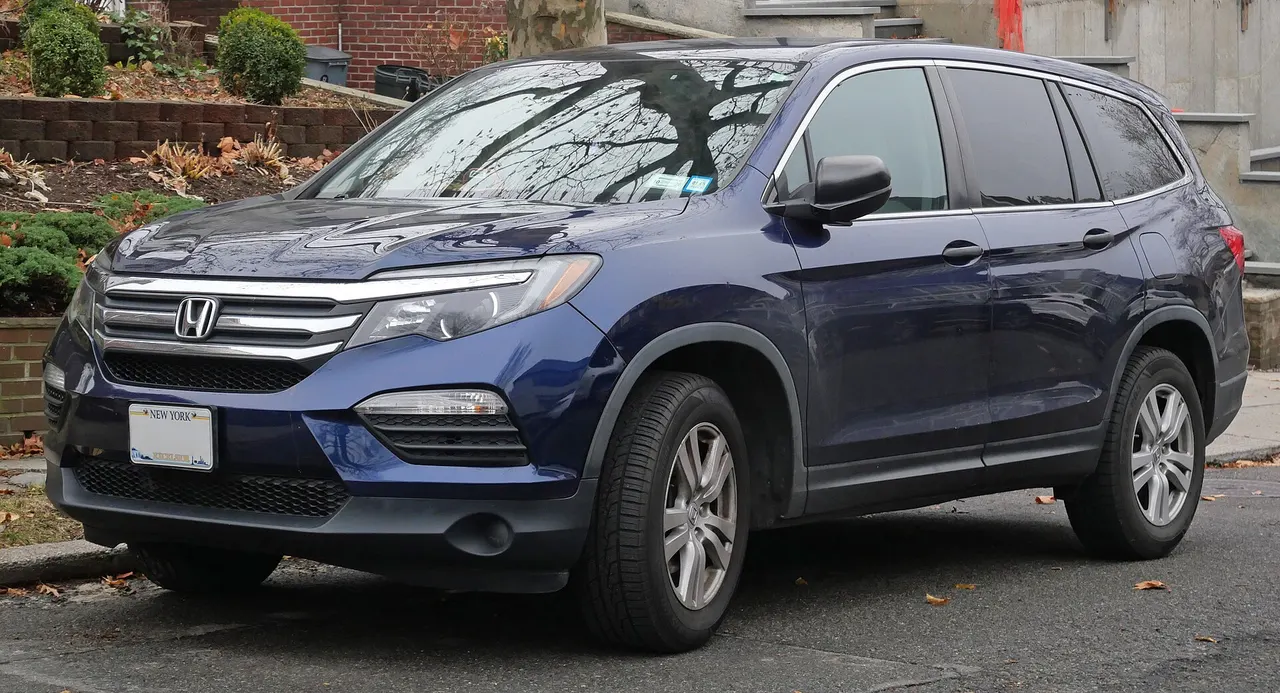
2016 Honda Pilot LX

Photo: 2016 Honda Pilot LX · Kevauto, CC BY-SA 4.0, via Wikimedia Commons

Problem areas

Ranked by severity-weighted complaints · share · median miles
  1. Electrical43% · 247 complaints · median 44,000 miles
  2. Engine20% · 114 complaints · median 42,000 miles
  3. Powertrain17% · 98 complaints · median 43,000 miles
  4. Fuel and propulsion11% · 64 complaints · median 49,000 miles
  5. Brakes9% · 49 complaints · median 30,000 miles
  6. Body and structure5% · 31 complaints · median 8,000 miles
  7. Speed control4% · 25 complaints · median 28,000 miles
  8. Air bags2% · 9 complaints · median 52,000 miles
  9. Wheels and tires2% · 9 complaints · median 24,000 miles
  10. Steering2% · 10 complaints · median 21,000 miles

Bars rank problem areas by complaints weighted for severity (crashes, fires, injuries and deaths count more). A complaint can name more than one area. Mileage is reported on about half of complaints.

What owners describe

Electrical

Many owners of this model year describe a recurring dashboard warning about the keyless start system and separate incidents where the engine stalls after the auto idle-stop feature engages at a stop. Dealers frequently could not replicate or permanently resolve these issues, leaving some owners stalled in traffic or unable to restart quickly.

Warning signs:
Owners report dashboard warning lights (keyless start, multiple system failure indicators), the engine cutting off after idle-stop, difficulty restarting, radio and displays shutting off, and instrument panel or infotainment screens going blank or freezing.
What shops did:
Dealers often could not duplicate or fix the issue; some replaced batteries, start buttons, or performed software/computer resets, but many owners say the problem returned.
Mileage:
most between 35,000 and 65,000 miles, among 302 complaints that give it

“Idle stop fuel saver feature causes car to stall when brake is disengage. My car has stalled numerous times.”

“My car intermittently gives me a warning about a "keyless start system problem," which began a couple of months ago.”

Engine

Owners describe their Pilot's engine cutting off unexpectedly, especially right after the auto idle-stop feature activates at intersections or in traffic, sometimes taking minutes to restart. Dealers often couldn't reproduce the stalling, and some owners report repeated visits and parts replacements without a lasting fix.

Warning signs:
Many mention radio cutting out, all warning lights illuminating, popping noises, or messages of system failures just before or during the stall.
What shops did:
Dealers frequently could not duplicate the problem, sometimes replaced the battery, starter, fuel injectors, or performed software updates, often without lasting resolution.
Mileage:
most between 40,000 and 105,000 miles, among 235 complaints that give it

“When engine tries to restart from idle stop the engine stalls and fails to restart.”

Powertrain

Owners describe transmission problems ranging from jerking and surging to stalling and unexpected shifts into neutral or park, sometimes with unusual noises. Many say dealers performed software updates, fluid flushes, or transmission replacements, though some report the issue recurring or being told there was no fix.

Warning signs:
Many mention grinding, whistling, or chirping noises when shifting, warning lights (transmission, emissions, AWD), RPM surges, and jerking or lurching during acceleration or deceleration.
What shops did:
Dealers often flushed or replaced transmission fluid, updated software, or replaced the transmission or cooler; some could not replicate or fix the problem, especially once out of warranty.
Mileage:
most between 25,000 and 70,000 miles, among 120 complaints that give it

“Chirping sound appeared at 19,000 miles followed by shuddering and difficulty shifting between 28-32 MPH”

“The overheating issue leads to a 'judder' in the transmission. The car accelerates in a very jerky way especially between 30 and 50”

Summaries are written with AI from the owner complaints shown on NHTSA's site and checked against them; quotes are word for word.

  • NHTSA 26V365000June 2026880,514 vehicles

    Suspension: rear · Structure: frame and members

    American Honda Motor Company (Honda) is recalling certain 2016-2022 Honda Pilot, 2017-2023 Ridgeline, 2019-2023 Passport, and 2014-2020 Acura MDX vehicles that were sold in Connecticut, Delaware, District of Columbia, Illinois, Indiana, Iowa, Kentucky, Maine, Maryland, Massachusetts, Michigan, Minnesota, Missouri, New Hampshire, New Jersey, New York, Ohio, Pennsylvania, Rhode Island, Vermont, Virginia, West Virginia, or Wisconsin. The rear subframe may corrode at the suspension mounting points, which can result in rear suspension component failure.

    Risk: Failure of rear suspension components, such as the rear control arm, can cause a loss of vehicle handling and control, increasing the risk of a crash or injury.

    Fix: Dealers will inspect the rear subframe and install a rear subframe reinforcement kit and, as necessary, repair or replace the rear subframe components, free of charge.

  • NHTSA 23V858000December 20232,490,460 vehicles

    Fuel system, gasoline: delivery: fuel pump

    Honda (American Honda Motor Co.) is recalling certain 2013-2023 Honda Accord, Civic Coupe, Civic Sedan, Civic Hatchback, Civic Type R, CR-V, HR-V, Ridgeline, Odyssey, Acura ILX, MDX, MDX Hybrid, RDX, RLX, TLX, 2019-2022 Honda Insight, Passport, 2020 Honda CR-V Hybrid, 2018-2019 Honda Clarity PHEV, Fit, and 2015-2020 Honda Accord Hybrid, Pilot, Acura NSX vehicles. The fuel pump inside the fuel tank may fail.

    Risk: Fuel pump failure can cause an engine stall while driving, increasing the risk of a crash.

    Fix: Dealers will replace the fuel pump module, free of charge.

  • NHTSA 23V751000November 2023248,999 vehicles

    Engine and engine cooling: engine: hard parts internal/mechanical

    Honda (American Honda Motor Co.) is recalling certain 2015-2020 Acura TLX, 2016-2020 Acura MDX, 2016 and 2018-2019 Pilot, 2017 and 2019 Ridgeline, and 2018-2019 Odyssey vehicles. Due to a manufacturing error, the connecting rod bearing in the engine may wear and seize, damaging the engine.

    Risk: A damaged engine may run improperly or stall while driving, increasing the risk of a fire, crash, or injury.

    Fix: Dealers will inspect and repair, or replace the engine as necessary, free of charge.

  • NHTSA 21V932000November 2021724,826 vehicles

    Latches/locks/linkages: hood: latch · Structure: body: hood

    Honda (American Honda Motor Co.) is recalling certain 2019 Passport, 2016-2019 Pilot, and 2017-2020 Ridgeline vehicles. The hood latch striker may become damaged and separate from the hood, which can result in the hood opening while driving.

    Risk: A hood that opens while driving can obstruct the driver's view and increase the risk of a crash.

    Fix: Dealers will either repair the hood latch striker, or replace the hood if necessary, free of charge.

  • NHTSA 17V219000March 2017136 vehicles

    Fuel system, gasoline: storage

    Honda (American Honda Motor Co.) is recalling certain 2016 Honda Pilot 2WD and AWD vehicles. The affected vehicles have fuel tanks that may leak.

    Risk: A fuel leak in the presence of an ignition source can increase the risk of a fire.

    Fix: Honda will notify owners, and dealers will replace the fuel tank, free of charge.

  • NHTSA 16V417000June 201639 vehicles

    Fuel system, gasoline: storage: tank assembly

    Honda (American Honda Motor Co.) is recalling certain model year 2015 Acura MDX 2WD and MDX 4WD vehicles, 2016 Acura MDX 4WD vehicles, 2015-2016 Honda Odyssey vehicles, and 2016 Honda Pilot 2WD and 4WD vehicles. The affected vehicles have fuel tanks that were manufactured with insufficient welds which may separate and allow fuel to leak out.

    Risk: A fuel leak in the presence of an ignition source may result in a fire.

    Fix: Honda will notify owners, and dealers will replace the fuel tanks, free of charge.

  • NHTSA 15V668000October 201535,406 vehicles

    Electrical system: instrument cluster/panel

    Honda (American Honda Motor Co.) is recalling certain model year 2016 Honda Pilot 2WD vehicles manufactured May 4, 2015, to September 8, 2015 and 2016 Pilot 4WD vehicles manufactured May 7, 2015 to September 4, 2015. In the affected vehicles, when one of the safety systems such as tire pressure monitoring, anti-lock braking or electronic stability control malfunctions, there is potential that the instrument panel will not illuminate the corresponding warning light, however the warning lamps will illuminate when the ignition is turned off and then turned back on. As such, these vehicles fail to comply with the requirements of Federal Motor Vehicle Safety Standard (FMVSS) number 126, "Electronic stability control systems", number 135, "Light vehicle brake systems" and number 138, "Tire pressure monitoring systems".

    Risk: If a safety system cannot immediately warn the driver when needed, the driver may be at increased risk of a crash.

    Fix: Honda will notify owners, and dealers will update the instrument cluster software, free of charge.

  • NHTSA 15V424000July 20151,358 vehicles

    Seat belts: rear/other

    Honda (American Honda Motor Co.) is recalling certain model year 2016 Honda Pilot vehicles manufactured May 4, 2015, to June 5, 2015. Due to an assembly issue, the third row seatbelt may be trapped between the rear seat and the rear sideliner.

    Risk: If the third row seatbelt is trapped, the occupants may not be restrained properly, increasing the risk of injury.

    Fix: Honda will notify owners, and dealers will inspect and repair the rear third row seat belt, free of charge.

A recall only helps if the repair was done. Enter the vehicle's 17-character VIN on NHTSA's official recall lookup before you buy.
Service bulletins

Honda sent NHTSA 365 service bulletins and other notices to dealers covering the 2016 Pilot. These are repair instructions, not recalls. Warranty extensions and bulletins about its top problem areas:

  • ONL6T603102023-2 · March 2023 · Warranty extensionWarranty Extension reimbursement form for engine idle stop repairs made before the warranty extension notice date.
  • ONL6T603102023-4 · March 2023 · Warranty extensionUnder certain circumstances, after coming to a stop and the idle stop feature engages, the vehicle may not automatically restart.
  • A23-009 · July 2025Under certain circumstances, after coming to a stop and engaging idle stop, the vehicle may not restart automatically due to excessive cylinder pressure and/or low cranking torque.
  • A16-013 · September 2024Drivers may experience a chirping sound coming from the engine area with the engine warmed up due to the high pressure fuel pump is making a chirp.
  • A24-085 · July 2024MIL flashes and vehicle will not accelerate, low power.
  • A23-008 · November 2023Under certain circumstances, after coming to a stop and the idle stop feature engages, the vehicle may not automatically restart.
  • A23-073 · September 2023The vehicle's transmission temperature can become too hot due to automatic transmission fluid deterioration causing high foaming and low viscosity.
  • A23-023 · April 2023The engine will not crank on initial startup after precipitation and sub-freezing temperatures.

All 2016 Pilot bulletins on NHTSA ›

Questions owners ask

Is the 2016 Honda Pilot reliable?
Owners filed 573 complaints with NHTSA about the 2016 Honda Pilot in its first five years on the road, about 460 for every 100,000 sold: 3.8× the rate of a typical Pilot year. That's more than twice a typical year, across more than one problem area. Ratings compare Pilot years with each other using complaints filed with NHTSA; they don't measure every problem owners have.
What are the most common 2016 Pilot problems?
Owners' complaints most often involve the electrical system (43%), the engine (20%) and the powertrain (transmission and drivetrain) (17%). A complaint can name more than one area.
Has the 2016 Honda Pilot been recalled?
Yes. NHTSA lists 8 recall campaigns for the 2016 Honda Pilot, the most recent in June 2026 (suspension). Enter the vehicle's VIN on NHTSA's recall lookup to see whether the repairs were done.

Sources

Owner complaints, recalls and manufacturer communications from NHTSA's public data files, as of September 24, 2026. Complaints are counted once each, over the model year's first 60 months on the road. UsedScore is not affiliated with NHTSA or Honda. The 2016 Honda Pilot on NHTSA.gov · How we rate