2012 Toyota Camry: Use caution

Owners filed 319 complaints with NHTSA about the 2012 Toyota Camry in its first five years on the road, about 84 for every 100,000 sold: 1.5× the rate of a typical Camry year. That's above average, so use caution.

The biggest problem area, counting serious complaints more, is the air bags (16% of complaints, median 23,000 miles).

Complaint index
1.5×
per vehicle sold, vs. a typical Camry year
Rank
10th of 14
1st = fewest complaints
Complaints
319
first five years; 84 per 100,000 sold
Recalls
2
campaigns
7th generation, 2012–2017 (first year of the generation; redesign years often run worse) · Updated September 24, 2026 · How we rate
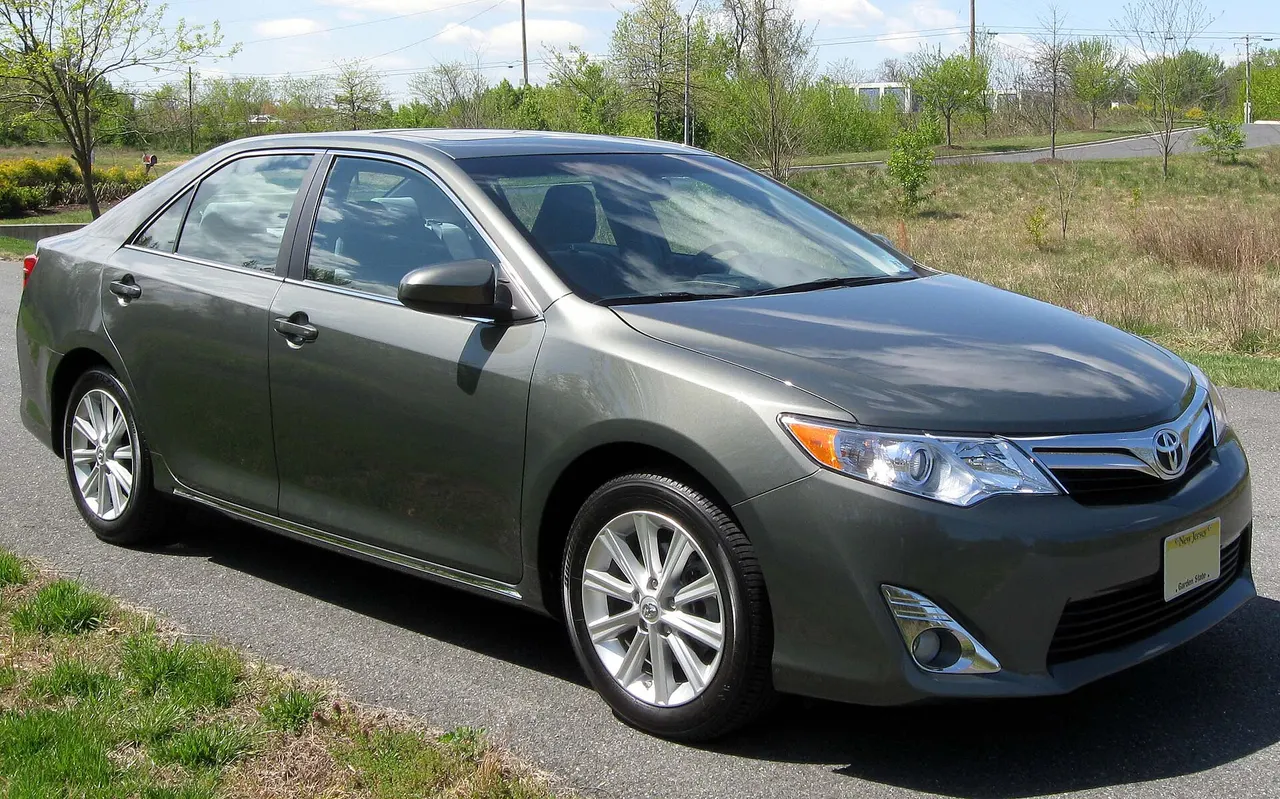
2012 Toyota Camry XLE

Photo: 2012 Toyota Camry XLE · IFCAR, public domain, via Wikimedia Commons

Problem areas

Ranked by severity-weighted complaints · share · median miles
  1. Air bags16% · 51 complaints · median 23,000 miles
  2. Speed control15% · 48 complaints · median 17,000 miles
  3. Brakes14% · 46 complaints · median 22,000 miles
  4. Body and structure17% · 53 complaints · median 16,000 miles
  5. Steering13% · 41 complaints · median 7,000 miles
  6. Electrical9% · 30 complaints · median 20,000 miles
  7. Powertrain12% · 38 complaints · median 28,000 miles
  8. Engine8% · 27 complaints · median 18,000 miles
  9. Fuel and propulsion5% · 15 complaints · median 14,000 miles
  10. Seats and belts4% · 14 complaints · median 24,000 miles

Bars rank problem areas by complaints weighted for severity (crashes, fires, injuries and deaths count more). A complaint can name more than one area. Mileage is reported on about half of complaints.

What owners describe

Air bags

Owners most often describe crashing into trees, walls, other vehicles, or rolling over, only to find that none of the air bags deployed, sometimes resulting in facial, neck, or chest injuries. A smaller number describe a recurring air bag or seat belt warning light that dealers struggled to fix, and a few mention a recall for the air bag control module with long repair wait times.

Warning signs:
Many report no dashboard warning before the crash, though some noticed a passenger air bag off light, an illuminated SRS/air bag warning lamp, or a locked steering wheel beforehand.
What shops did:
Some owners say dealers could not diagnose or duplicate the warning light issue, replaced a brake actuator or spiral cable, or performed a recall-related air bag control module repair, sometimes delayed by part shortages.
Mileage:
most between 15,000 and 60,000 miles, among 61 complaints that give it

“The vehicle then flipped end over end four times until coming to a rest on its roof”

“Not a single one of the many air bags in my toyota camry deployed”

Brakes

Owners of this Camry describe brakes that suddenly failed to stop the car, sometimes at low speed while parking, along with dashboard warning lights and unusual noises. Many say dealers couldn't find a problem or blamed sensors, while others were told an expensive brake actuator or booster replacement was needed.

Warning signs:
Many mention ABS, brake, traction control or master warning lights illuminating, unusual noises, grinding, whistling or burning smells, and hot wheels before the braking problem occurred.
What shops did:
Dealers often could not duplicate or diagnose the issue, sometimes calling it normal, while others replaced a brake actuator, brake booster, caliper, or brake light switch.
Mileage:
most between 15,000 and 55,000 miles, among 59 complaints that give it

“I suddenly had no power braking and had to stomp on the brakes to avoid a collision”

“I would experience a severe decrease in brake function (I would need to slam on the brakes to get them to apply properly)”

Speed control

Many owners describe their 2012 Camry suddenly accelerating, hesitating, or stalling with little or no warning, sometimes while parking or turning. Dealers frequently could not reproduce the issue, though some replaced parts or updated software with mixed results.

Warning signs:
Some owners noticed RPM surges, delayed accelerator response, shuddering, or the vehicle briefly not responding before acceleration or stalling occurred.
What shops did:
Dealers often could not duplicate or diagnose the problem; some replaced a torque converter, throttle control, or updated software, without always resolving it.
Mileage:
most between 10,000 and 55,000 miles, among 59 complaints that give it

“The rpms increased and the vehicle independently accelerated. The contact continued to depress the brake pedal but the vehicle would not respond.”

“The vehicle will move about 20 feet or 20 MPH and then hesitate for about 1 to 2 seconds. It will then accelerate normally.”

Summaries are written with AI from the owner complaints shown on NHTSA's site and checked against them; quotes are word for word.

  • NHTSA 13V442000October 2013802,769 vehicles

    Equipment: appliance: air conditioner · Air bags · Electrical system

    Toyota is recalling certain model year 2012-2013 Avalon, Avalon HV, Venza, Camry, and Camry HV vehicles. In the affected vehicles, the drain hose for the air conditioning condenser may become clogged causing water to accumulate at the bottom of the air conditioning condenser unit housing. The accumulated water may then leak through a seam in the housing onto the air bag control module potentially resulting in a short circuit of the module.

    Risk: A short circuit may cause the air bags to become disabled or inadvertently deploy. An inadvertent airbag deployment can increase the risk of injury or the possibility of a crash. An inoperative airbag can increase the risk of injury in a severe crash. The power steering assist could also become inoperable resulting in increased steering effort and can increase the risk of a crash at low speeds.

    Fix: Toyota will notify owners, and dealers will seal the air conditioning condenser unit housing and install a protective cover on the airbag control module, free of charge.

  • NHTSA 13V014000January 20133,235 vehicles

    Seats · Air bags: frontal: sensor/control module-inactive

    Southeast Toyota Distributors, LLC (SET) is recalling certain models interspersed through model years 2009 through 2013 as follows: model year 2009-2012 Tacoma, 4Runner, Camry, Camry Hybrid, Prius, and RAV4; model year 2009-2010 Avalon, FJ Cruiser, and Highlander Hybrid; model year 2010-2013 model year Corolla, Sienna and Tundra; model year 2009-2013 Highlander and Venza; model year 2012 Prius V; and model year 2010-2012 Sequoia. During modification by SET to include accessories such as leather seat covers, seat heaters or headrest DVD systems, these vehicles may not have had the passenger seat occupant sensing system calibration tested. Without passing the calibration test, the occupant sensing system may not operate as designed.

    Risk: If the front passenger seat occupant sensing system is out of calibration, the front passenger airbags may not deploy or they may deploy inappropriately for the passenger's size and position. This could increase the risk of personal injury during the event of a vehicle crash necessitating airbag deployment.

    Fix: Southeast Toyota will notify owners, and dealers will test the sensitivity of the occupant detection sensors, and recalibrate them as necessary.

A recall only helps if the repair was done. Enter the vehicle's 17-character VIN on NHTSA's official recall lookup before you buy.

Service bulletins

Toyota sent NHTSA 566 service bulletins and other notices to dealers covering the 2012 Camry. These are repair instructions, not recalls. Warranty extensions and bulletins about its top problem areas:

  • TSB003220 · August 2023TSB: Replacement certification labels (the vinyl label installed on the driver door or door post) and VIN plates (the metal plate riveted to dashboard) (see Figure 1) for most 1979 ?
  • T-SB-0094-21 Rev · November 2022TSB: Some 2005 ?
  • TTT063620 · March 2022TT: Some Toyota vehicles installed with Toyota Complete Maintenance Care (TCMC) brake pads may exhibit a groan or squeak noise in various driving conditions
  • Toyota Safety Re · March 2021Toyota Safety Recall and Service Campaign - Technician Certification Requirements
  • T-TT-0636-20 Rev · March 2021TT: Some Toyota vehicles installed with Toyota Complete Maintenance Care (TCMC) brake pads may exhibit a groan or squeak noise in various driving conditions.
  • T-TT-0636-20 · December 2020TT: Some Toyota vehicles installed with Toyota Complete Maintenance Care (TCMC) brake pads may exhibit a groan or squeak noise in various driving conditions.
  • ZKK - Dealer Pac · August 2020DL: Toyota has received reports regarding the Brake Booster and Brake Booster Pump Assemblies on certain 2012 - 2014 model year Camry Hybrid vehicles and certain 2013 - 2015 model year Avalon Hybrid…
  • ZKK_Dealer Email · September 2019Dealer Email: Toyota has received reports regarding the Brake Booster and Brake Booster Pump Assemblies on certain 2012 - 2014 model year Camry Hybrid vehicles and certain 2013 - 2015 model year…

All 2012 Camry bulletins on NHTSA ›

Questions owners ask

Is the 2012 Toyota Camry reliable?
Owners filed 319 complaints with NHTSA about the 2012 Toyota Camry in its first five years on the road, about 84 for every 100,000 sold: 1.5× the rate of a typical Camry year. That's above average, so use caution. Ratings compare Camry years with each other using complaints filed with NHTSA; they don't measure every problem owners have.
What are the most common 2012 Camry problems?
Owners' complaints most often involve the air bags (16%), speed control (15%) and the brakes (14%). A complaint can name more than one area.
Has the 2012 Toyota Camry been recalled?
Yes. NHTSA lists 2 recall campaigns for the 2012 Toyota Camry, the most recent in October 2013 (equipment). Enter the vehicle's VIN on NHTSA's recall lookup to see whether the repairs were done.

Sources

Owner complaints, recalls and manufacturer communications from NHTSA's public data files, as of September 24, 2026. Complaints are counted once each, over the model year's first 60 months on the road. UsedScore is not affiliated with NHTSA or Toyota. The 2012 Toyota Camry on NHTSA.gov · How we rate