2012 Toyota Highlander: Solid

Owners filed 72 complaints with NHTSA about the 2012 Toyota Highlander in its first five years on the road, about 62 for every 100,000 sold: 0.9× the rate of a typical Highlander year. That's close to a typical year.

The biggest problem area, counting serious complaints more, is speed control (15% of complaints, median 7,000 miles).

Complaint index
0.9×
per vehicle sold, vs. a typical Highlander year
Rank
4th of 14
1st = fewest complaints
Complaints
72
first five years; 62 per 100,000 sold
Recalls
2
campaigns
2nd generation, 2008–2013 · Updated September 24, 2026 · How we rate
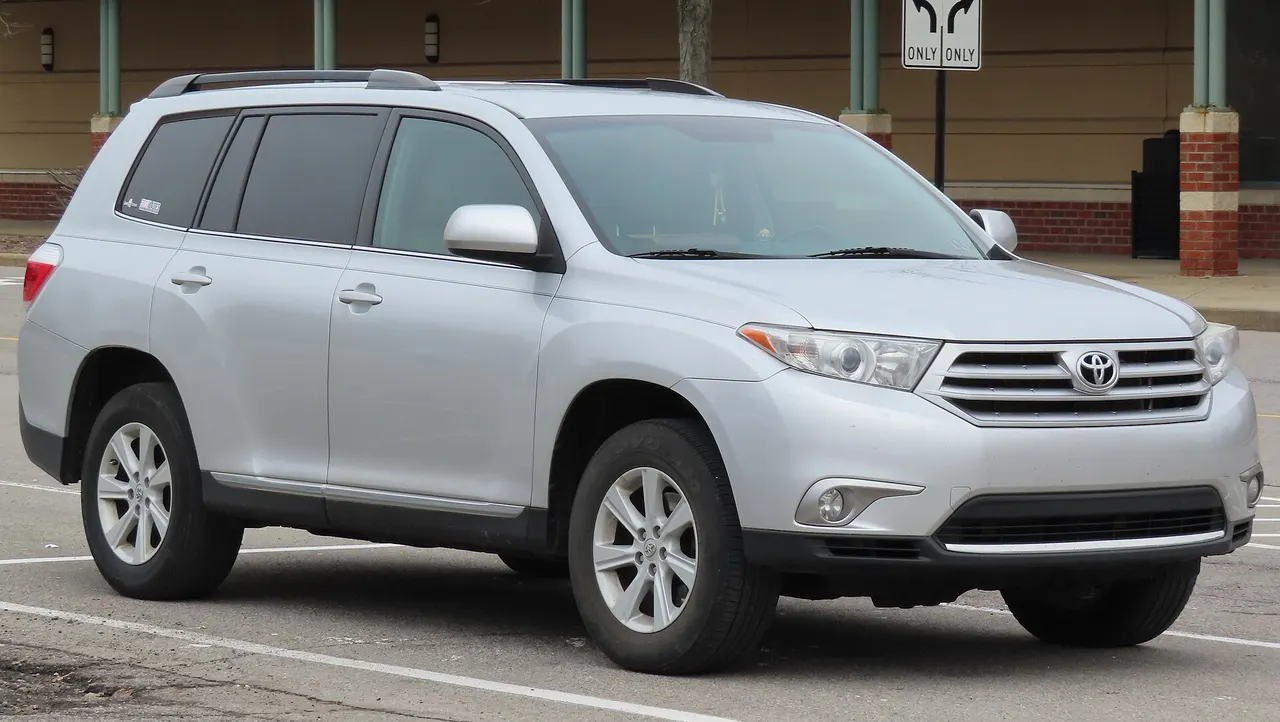
2011–2013 Toyota Highlander

Photo: 2011–2013 Toyota Highlander · MercurySable99, CC BY-SA 4.0, via Wikimedia Commons

Problem areas

Ranked by severity-weighted complaints · share · median miles
  1. Speed control15% · 11 complaints · median 7,000 miles
  2. Air bags6% · 4 complaints
  3. Body and structure14% · 10 complaints · median 20,000 miles
  4. Electrical17% · 12 complaints · median 31,000 miles
  5. Engine11% · 8 complaints · median 7,000 miles
  6. Steering11% · 8 complaints · median 45,000 miles
  7. Visibility18% · 13 complaints · median 34,000 miles
  8. Brakes6% · 4 complaints
  9. Powertrain8% · 6 complaints · median 13,000 miles
  10. Fuel and propulsion6% · 4 complaints

Bars rank problem areas by complaints weighted for severity (crashes, fires, injuries and deaths count more). A complaint can name more than one area. Mileage is reported on about half of complaints.

What owners describe

Air bags

Owners describe air bags that failed to deploy during crashes, sometimes resulting in injuries, as well as recurring air bag warning lights tied to the passenger seat sensor. Some say dealer repairs did not permanently fix the warning light problem.

Warning signs:
Some owners noticed the SRS or passenger air bag warning light coming on, sometimes with a message to see a dealer, before deployment failures.
What shops did:
Some owners had dealers perform diagnostics or seat sensor calibration, though a few say repeated dealer attempts did not resolve the warning light issue.
Mileage:
most between 10,000 and 50,000 miles, among 7 complaints that give it

“Toyota Dealer has tried to fix airbags three times in three weeks but it fails within a day or so and warning comes back on.”

“The warning lights and display went off just after someone sat in the passenger seat.”

Body and structure

Owners of this Highlander describe recurring liftgate problems, from doors closing unexpectedly to detaching arms, along with water leaks, sunroof glass breakage, and paint issues. Many say dealers diagnosed the same failures repeatedly, sometimes declining warranty coverage even when owners found related service bulletins or recalls.

Warning signs:
Owners report clunking noises, gaps when closing, wet carpets or musty smells, loud popping sounds, and doors that won't unlock or lock properly before failures occurred.
What shops did:
Dealers replaced or adjusted liftgate motors, hinges, and lock actuators, diagnosed clogged A/C or sunroof drains, and in some cases declined to cover repairs under warranty.
Mileage:
most between 15,000 and 65,000 miles, among 13 complaints that give it

“Rear liftgate arm detached from door. The bolt that attaches the liftgate arm to the door stripped.”

“Liftgate operates erratically, not staying open when button is pushed. Sometimes it opens all the way, only to close immediately.”

Speed control

Owners describe their Highlanders suddenly accelerating on their own, often while parking or coming to a stop, sometimes with brakes that felt stiff or unresponsive. Several report crashes into walls, curbs, or objects, with dealers or Toyota often finding no defect afterward.

Warning signs:
Owners noticed the engine revving or racing, a stiff or hard brake pedal, and vibration just before the vehicle accelerated on its own.
What shops did:
Some owners report dealers or manufacturer engineers inspected the vehicle but found no defect and did not repair it; a few report no repair was attempted at all.
Mileage:
most between 5,000 and 15,000 miles, among 12 complaints that give it

“The brake pedal had become very stiff. She had to apply extreme pressure to the brake and the vehicle stopped 15 feet later.”

“Brake pedal was rock hard no response. Two more attempts useless.”

Summaries are written with AI from the owner complaints shown on NHTSA's site and checked against them; quotes are word for word.

  • NHTSA 13V123000April 20137,525 vehicles

    Equipment: other: labels

    Southeast Toyota is recalling certain model year 2008 and 2010-2013 Toyota Tundra, 2010-2012 Rav4, 2012 Toyota Sequoia, 2010-2011 Toyota Corolla, 2010-2011 Toyota Camry and Camry Hybrid, 2010-2013 Toyota Highlander and Highlander Hybrid, 2010-2013 Toyota FJ Cruiser, 2011 Toyota Land Cruiser, 2010-2013 Toyota Venza, 2010-2011 Toyota 4Runner, 2010-2013 Toyota Tacoma, 2011-2012 Toyota Sienna, 2012 Toyota Prius, 2013 Scion FR-S, 2011 Scion XD, 2011 Scion XB, and 2012 Scion TC vehicles. These vehicles were sold with labels that were outside the allowable one percent of accuracy of actual weight added. Thus, these vehicles fail to comply with the requirements of Federal Motor Vehicle Safety Standard (FMVSS) Number 110, "Tire Selection and Rims."

    Risk: An inaccurate label could lead to owners overloading their vehicles and tires. An overloaded vehicle can result in a tire failure which may result in a vehicle crash, personal injury, or property damage.

    Fix: Southeast Toyota will notify owners and provide a corrected label with instructions concerning its installation.

  • NHTSA 13V014000January 20133,235 vehicles

    Seats · Air bags: frontal: sensor/control module-inactive

    Southeast Toyota Distributors, LLC (SET) is recalling certain models interspersed through model years 2009 through 2013 as follows: model year 2009-2012 Tacoma, 4Runner, Camry, Camry Hybrid, Prius, and RAV4; model year 2009-2010 Avalon, FJ Cruiser, and Highlander Hybrid; model year 2010-2013 model year Corolla, Sienna and Tundra; model year 2009-2013 Highlander and Venza; model year 2012 Prius V; and model year 2010-2012 Sequoia. During modification by SET to include accessories such as leather seat covers, seat heaters or headrest DVD systems, these vehicles may not have had the passenger seat occupant sensing system calibration tested. Without passing the calibration test, the occupant sensing system may not operate as designed.

    Risk: If the front passenger seat occupant sensing system is out of calibration, the front passenger airbags may not deploy or they may deploy inappropriately for the passenger's size and position. This could increase the risk of personal injury during the event of a vehicle crash necessitating airbag deployment.

    Fix: Southeast Toyota will notify owners, and dealers will test the sensitivity of the occupant detection sensors, and recalibrate them as necessary.

A recall only helps if the repair was done. Enter the vehicle's 17-character VIN on NHTSA's official recall lookup before you buy.

Service bulletins

Toyota sent NHTSA 340 service bulletins and other notices to dealers covering the 2012 Highlander. These are repair instructions, not recalls. Warranty extensions and bulletins about its top problem areas:

  • T-SB-0035-24 Rev2 · December 2024Acid rain results from rainwater or other airborne moisture that become acidic due to industrial chemical impurities in the atmosphere.
  • T-SB-0038-24 Rev2 · December 2024To prevent brake rotor rust from forming during transportation and storage, wheel film will be used instead of a cardboard type of anti-rust cover.
  • T-SB-0039-24 Rev2 · December 2024The condition known as acid rain is caused by airborne chemicals or particles in the atmosphere, which mix with rainwater, nighttime dew, or high humidity to form acidic compounds.
  • T-SB-0061-23 Rev2 · December 2024Toyota vehicles are currently protected with RapgardTM protective film designed to protect the horizontal painted surfaces.
  • T-SB-0062-23 Rev2 · December 2024Vehicles may occasionally be subjected to contamination by airborne iron particles shed from railroad tracks, train wheels, exposure to heavy machinery facilities, grinding, welding, etc.
  • T-SB-0055-24 Rev1 · July 2024Some 2005 – 2024 Toyota vehicles that have undergone water intrusion may exhibit a condition in which a musty odor is present.
  • T-SB-0035-24 Rev1 · July 2024Acid rain results from rainwater or other airborne moisture that become acidic due to industrial chemical impurities in the atmosphere.
  • T-SB-0038-24 Rev1 · July 2024To prevent brake rotor rust from forming during transportation and storage, wheel film will be used instead of a cardboard type of anti-rust cover.

All 2012 Highlander bulletins on NHTSA ›

Questions owners ask

Is the 2012 Toyota Highlander reliable?
Owners filed 72 complaints with NHTSA about the 2012 Toyota Highlander in its first five years on the road, about 62 for every 100,000 sold: 0.9× the rate of a typical Highlander year. That's close to a typical year. Ratings compare Highlander years with each other using complaints filed with NHTSA; they don't measure every problem owners have.
What are the most common 2012 Highlander problems?
Owners' complaints most often involve speed control (15%), the air bags (6%) and the body and structure (14%). A complaint can name more than one area.
Has the 2012 Toyota Highlander been recalled?
Yes. NHTSA lists 2 recall campaigns for the 2012 Toyota Highlander, the most recent in April 2013 (equipment). Enter the vehicle's VIN on NHTSA's recall lookup to see whether the repairs were done.

Sources

Owner complaints, recalls and manufacturer communications from NHTSA's public data files, as of September 24, 2026. Complaints are counted once each, over the model year's first 60 months on the road. UsedScore is not affiliated with NHTSA or Toyota. The 2012 Toyota Highlander on NHTSA.gov · How we rate