2015 Honda CR-V: Use caution

Owners filed 488 complaints with NHTSA about the 2015 Honda CR-V in its first five years on the road, about 142 for every 100,000 sold: 1.8× the rate of a typical CR-V year. That's above average, so use caution.

The biggest problem area, counting serious complaints more, is the engine (40% of complaints, median 1,000 miles).

Complaint index
1.8×
per vehicle sold, vs. a typical CR-V year
Rank
12th of 14
1st = fewest complaints
Complaints
488
first five years; 142 per 100,000 sold
Recalls
3
campaigns
4th generation, 2012–2016 · Updated September 24, 2026 · How we rate
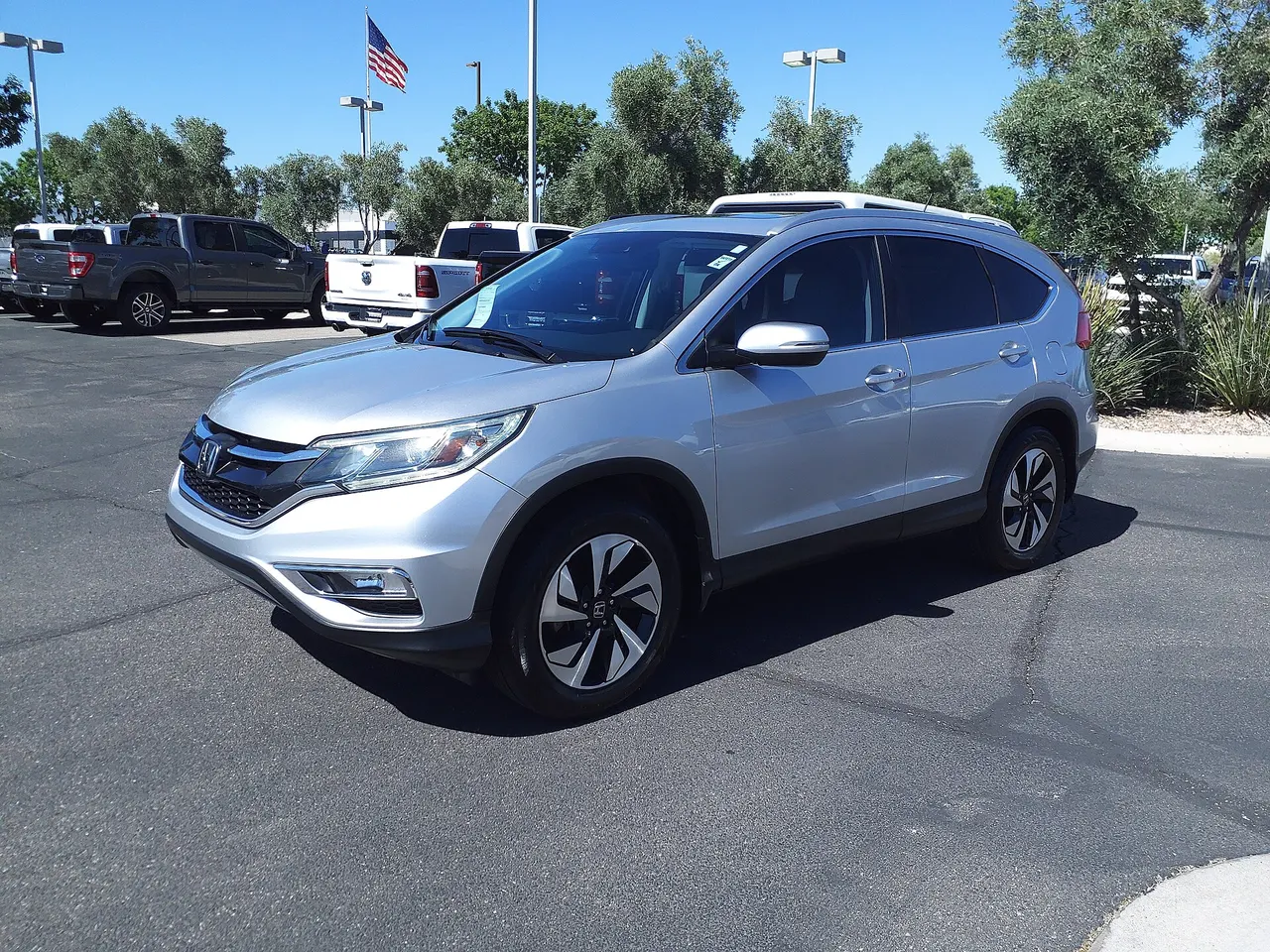
2016 Honda CR-V Touring (facelift)

Photo: 2016 Honda CR-V Touring (facelift) · HJUdall, CC0, via Wikimedia Commons

Problem areas

Ranked by severity-weighted complaints · share · median miles
  1. Engine40% · 193 complaints · median 1,000 miles
  2. Powertrain25% · 122 complaints · median 1,000 miles
  3. Brakes8% · 38 complaints · median 8,000 miles
  4. Air bags3% · 16 complaints · median 14,000 miles
  5. Seats and belts8% · 40 complaints · median 1,000 miles
  6. Speed control5% · 26 complaints · median 8,000 miles
  7. Steering8% · 39 complaints · median 2,000 miles
  8. Electrical8% · 40 complaints · median 15,000 miles
  9. Body and structure5% · 26 complaints · median 1,000 miles
  10. Fuel and propulsion3% · 16 complaints · median 9,000 miles

Bars rank problem areas by complaints weighted for severity (crashes, fires, injuries and deaths count more). A complaint can name more than one area. Mileage is reported on about half of complaints.

What owners describe

Brakes

Owners of this CR-V commonly describe a persistent vibration felt through the seat and pedal when stopped with the brake applied, which dealers often called normal. Some also report frightening incidents where the car didn't stop or lurched forward despite braking, occasionally resulting in minor collisions.

Warning signs:
Many owners report strong vibration or shaking felt in the seat, steering wheel and body when idling with the brake pedal pressed, sometimes with dash warning lights illuminated.
What shops did:
Dealers often told owners the vibration was normal or a vehicle characteristic, and in several sudden-acceleration cases technicians found no fault and returned the vehicle unrepaired; some brake pad, rotor, parking brake or ABS module components were replaced.
Mileage:
most between 0 and 35,000 miles, among 41 complaints that give it

“Customer states the car has a vibration when stopped and foot on brake. It comes through the brake and the seat base and the back of the seat.”

“The brakes became very mushy and had to be depressed all the way to the floor in order to initiate braking.”

Engine

Many owners of this model year report a persistent vibration or shudder at idle and during light acceleration, along with occasional stalling or hesitation. Dealers frequently could not fix it, sometimes citing pending software updates or calling it normal for the vehicle.

Warning signs:
Owners notice RPM dropping very low (around 500-700) at stops, shaking felt in seats, steering wheel and pedals, and occasional engine racing or hesitation when accelerating or going downhill.
What shops did:
Dealers often confirmed the vibration but said there was no fix, called it a normal characteristic, or performed software/ECM updates that owners say didn't resolve the problem.
Mileage:
most between 0 and 25,000 miles, among 195 complaints that give it

“While driving at an unknown speed, the vehicle stalled, decelerated, and lost power. The failure occurred without warning.”

Powertrain

Owners commonly report a strong vibration or shudder when idling in drive or accelerating at low speeds, which dealers often couldn't fully resolve despite repeated visits and software updates. Some owners also describe more serious powertrain problems like stalling, loss of power, or transmission failure.

Warning signs:
Many describe the vehicle shaking noticeably throughout the cabin, steering wheel, and seats when stopped in gear with RPMs dropping, plus shuddering when accelerating.
What shops did:
Dealers often could not diagnose or permanently fix the issue, though some applied software updates, mounting brackets, or headrest changes with limited or no improvement; some transmissions were later replaced.
Mileage:
most between 0 and 10,000 miles, among 117 complaints that give it

“At steady speeds between 20 - 45 MPH, 2015 honda cr-v ex AWD vibrates/shudders badly when you try to increase speed slightly”

“Rpm does drop to about 500 RPM for about a second, making vehicle feel as if it will stall”

Summaries are written with AI from the owner complaints shown on NHTSA's site and checked against them; quotes are word for word.

  • NHTSA 23V858000December 20232,490,460 vehicles

    Fuel system, gasoline: delivery: fuel pump

    Honda (American Honda Motor Co.) is recalling certain 2013-2023 Honda Accord, Civic Coupe, Civic Sedan, Civic Hatchback, Civic Type R, CR-V, HR-V, Ridgeline, Odyssey, Acura ILX, MDX, MDX Hybrid, RDX, RLX, TLX, 2019-2022 Honda Insight, Passport, 2020 Honda CR-V Hybrid, 2018-2019 Honda Clarity PHEV, Fit, and 2015-2020 Honda Accord Hybrid, Pilot, Acura NSX vehicles. The fuel pump inside the fuel tank may fail.

    Risk: Fuel pump failure can cause an engine stall while driving, increasing the risk of a crash.

    Fix: Dealers will replace the fuel pump module, free of charge.

  • NHTSA 17V305000May 201716 vehicles

    Engine

    Honda (American Honda Motor Co.) is recalling certain 2015-2016 Honda CR-V vehicles that recently received a replacement engine. The replacement engine may have been built with the wrong pistons, potentially affecting the engine's performance.

    Risk: The reduced performance may result in an engine stall, increasing the risk of a crash.

    Fix: Honda will notify owners, and dealers will inspect the engines and replace the incorrect components, as necessary, free of charge.

  • NHTSA 15V121000March 2015137 vehicles

    Engine and engine cooling: engine

    American Honda Motor Co. (Honda) is recalling certain model year 2014 Accord L4 vehicles manufactured July 29, 2014, to July 31, 2014, 2015 Accord L4 vehicles manufactured August 14, 2014, to January 30, 2015, and 2015 CR-V vehicles manufactured September 9, 2014, to February 6, 2015. The affected vehicles may have been assembled with improperly torqued connecting rod bolts, which can cause the engine to lose power or leak oil.

    Risk: Loss of engine power may result in a vehicle stall, increasing the risk of a crash. If the engine leaks oil in the proximity of hot engine or exhaust components, there is an increased risk of a fire.

    Fix: Honda will notify owners, and dealers will replace the engine short block, free of charge.

A recall only helps if the repair was done. Enter the vehicle's 17-character VIN on NHTSA's official recall lookup before you buy.

Service bulletins

Honda sent NHTSA 133 service bulletins and other notices to dealers covering the 2015 CR-V. These are repair instructions, not recalls. Warranty extensions and bulletins about its top problem areas:

  • A18-072 · October 2019When cold-starting the engine and shifting to Reverse, the engine stalls in the first 10 to 14 seconds.
  • AAHM09242019 · September 2019Dealer Message - On December 2, 2015, Honda issued Service Bulletin 15-046 "Vibration While Driving and/or Stopped in Gear." This Service Bulletin and the product enhancements provided therein were…
  • AAHM06262019 · June 2019Dealer Message - On December 2, 2015, Honda issued Service Bulletin 15-046 "Vibration While Driving and/or Stopped in Gear." This Service Bulletin and the product enhancements provided therein were…
  • AHL03202019 · March 2019Dealer Message - On December 2, 2015, Honda issued Service Bulletin 15-046 "Vibration While Driving and/or Stopped in Gear." This Service Bulletin and the product enhancements provided therein were…
  • A19-019 · February 2019There is a knocking or clicking from the engine during cold startup.
  • AHL12192018901 · December 2018"Dealer message - On December 2, 2015, Honda issued Service Bulletin 15-046 "Vibration While Driving and/or Stopped in Gear." This Service Bulletin and the product enhancements provided therein were…
  • A15-046 · September 2018Some customers have reported feeling one or more different vibrations felt primarily through the driver?s seat.
  • AHL06252018901 · June 2018Dealer message - On December 2, 2015, Honda issued Service Bulletin 15-046 ?Vibration While Driving and/or Stopped in Gear." This Service Bulletin and the product enhancements provided therein were…

All 2015 CR-V bulletins on NHTSA ›

Questions owners ask

Is the 2015 Honda CR-V reliable?
Owners filed 488 complaints with NHTSA about the 2015 Honda CR-V in its first five years on the road, about 142 for every 100,000 sold: 1.8× the rate of a typical CR-V year. That's above average, so use caution. Ratings compare CR-V years with each other using complaints filed with NHTSA; they don't measure every problem owners have.
What are the most common 2015 CR-V problems?
Owners' complaints most often involve the engine (40%), the powertrain (transmission and drivetrain) (25%) and the brakes (8%). A complaint can name more than one area.
Has the 2015 Honda CR-V been recalled?
Yes. NHTSA lists 3 recall campaigns for the 2015 Honda CR-V, the most recent in December 2023 (fuel system, gasoline). Enter the vehicle's VIN on NHTSA's recall lookup to see whether the repairs were done.

Sources

Owner complaints, recalls and manufacturer communications from NHTSA's public data files, as of September 24, 2026. Complaints are counted once each, over the model year's first 60 months on the road. UsedScore is not affiliated with NHTSA or Honda. The 2015 Honda CR-V on NHTSA.gov · How we rate