2021 Honda CR-V: Solid

Owners filed 316 complaints with NHTSA about the 2021 Honda CR-V in its first five years on the road, about 89 for every 100,000 sold: 1.1× the rate of a typical CR-V year. That's close to a typical year.

The biggest problem area, counting serious complaints more, is driver-assistance features and cameras (31% of complaints, median 19,000 miles).

Complaint index
1.1×
per vehicle sold, vs. a typical CR-V year
Rank
9th of 14
1st = fewest complaints
Complaints
316
first five years; 89 per 100,000 sold
Recalls
5
campaigns
5th generation, 2017–2022 · Updated September 24, 2026 · How we rate
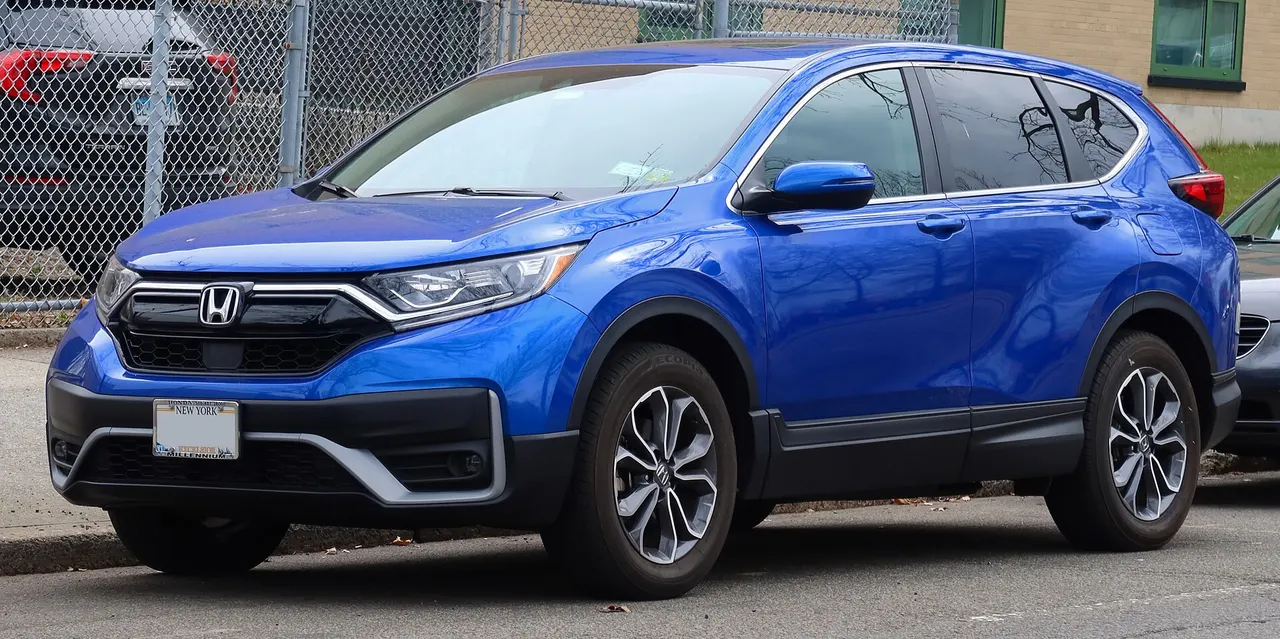
2021 Honda CR-V EX (facelift)

Photo: 2021 Honda CR-V EX (facelift) · Kevauto, CC BY-SA 4.0, via Wikimedia Commons

Problem areas

Ranked by severity-weighted complaints · share · median miles
  1. Driver assistance31% · 97 complaints · median 19,000 miles
  2. Steering22% · 69 complaints · median 33,000 miles
  3. Electrical14% · 45 complaints · median 10,000 miles
  4. Engine14% · 43 complaints · median 23,000 miles
  5. Brakes9% · 29 complaints · median 10,000 miles
  6. Air bags5% · 15 complaints
  7. Fuel and propulsion8% · 26 complaints
  8. Speed control5% · 15 complaints
  9. Powertrain5% · 15 complaints · median 16,000 miles
  10. Seats and belts2% · 5 complaints

Bars rank problem areas by complaints weighted for severity (crashes, fires, injuries and deaths count more). A complaint can name more than one area. Mileage is reported on about half of complaints.

What owners describe

Driver assistance

Owners frequently report the CR-V's automatic braking system slams on the brakes unexpectedly, even with clear roads and no obstacles, sometimes at highway speed. Many say dealers could not reproduce or fix the issue, leaving them unsure whether it will happen again.

Warning signs:
Many describe a beeping alert and a red "BRAKE" warning on the dash appearing just before or during the sudden braking, sometimes with no warning at all.
What shops did:
Dealers often could not duplicate or find a fault, sometimes ran diagnostics with no codes found, occasionally lowered sensor sensitivity, or told owners to disable the feature.
Mileage:
most between 10,000 and 55,000 miles, among 12 complaints that give it

“Vehicle will frequently brake at full capacity on its own for cars in the next lane of traffic.”

“the automatic emergency braking will engage after a vehicle, formerly in front, has completed a right hand turn”

Electrical

Owners of this CR-V describe unpredictable electrical issues, including sudden loss of power or stalling at highway speeds, unexpected automatic braking, and dashboard lights flashing on and off. Many say dealers struggled to diagnose the cause, and some mention waiting on parts for a related electrical recall.

Warning signs:
Many report warning lights (battery, check engine, brake, ABS) illuminating suddenly, along with rough idling, shaking, or a drop in battery voltage before power loss.
What shops did:
Dealers often could not duplicate or find diagnostic codes for the problem; some replaced batteries, fuel injectors, or steering gearboxes, while many report waiting for recall parts that were unavailable.
Mileage:
most between 0 and 25,000 miles, among 10 complaints that give it

“the battery indicator goes to zero and engine loses power and you can't accelerate”

“the check engine light began flashing. The engine lost power and would not accelerate beyond 40 mph”

Steering

Owners describe the steering wheel sticking or catching during turns, sometimes followed by a jerky overcorrection, often diagnosed as a failed power steering rack or gearbox. Many say this closely matches a known recall for newer CR-Vs but were told their 2021 model wasn't covered, leaving repairs costly and out of pocket.

Warning signs:
Many report a sticky or stiff feeling when turning, a clicking or popping noise, and a sudden jerk or overcorrection when the wheel finally releases, with no warning lights.
What shops did:
Dealers frequently diagnosed a failed power steering rack, gearbox, or worm gear needing replacement, though some could not duplicate the issue, parts were on backorder, and many owners were told their VIN was excluded from the related recall.
Mileage:
most between 35,000 and 50,000 miles, among 19 complaints that give it

“the steering wheel gets "stuck" and resists being turned. Then, when more force is applied to turn the wheel, the steering mechanism suddenly "lets go”

Summaries are written with AI from the owner complaints shown on NHTSA's site and checked against them; quotes are word for word.

  • NHTSA 26V332000May 202698,892 vehicles

    Air bags: sensor: occupant classification: front passenger

    Honda (American Honda Motor Co.) is recalling certain 2018-2021, 2023 Acura TLX, 2019-2024 RDX, 2017-2020, 2022-2026 MDX, 2017-2021, 2023, 2025 Honda Ridgeline, 2017-2022 Pilot, 2019-2021 Passport, 2018-2026 Odyssey, 2019-2022 Insight, 2019-2021 HR-V, 2018-2020 Fit, 2020-2022 CR-V Hybrid, 2017-2022 CR-V, 2017-2018, 2021 Civic Type R, 2017-2021 Civic hatchback, 2016-2020 Civic coupe, 2016-2022 Civic, 2017-2022 Accord Hybrid, and 2016-2022 Accord vehicles. The front passenger seat weight sensor may crack and short circuit, which can cause the air bags to deploy unintentionally during a crash.

    Risk: Air bags that deploy unintentionally during a crash increase the risk of injury.

    Fix: Dealers will replace the seat weight sensors, free of charge.

  • NHTSA 24V064000February 2024750,114 vehicles

    Air bags: sensor: occupant classification: front passenger

    Honda (American Honda Motor Co.) is recalling certain 2020-2022 Pilot, Accord, Civic sedan, HR-V, Odyssey, 2020 Civic coupe, Fit, 2021-2022 Civic hatchback, 2021 Civic Type R, Insight, 2020-2021 CR-V, CR-V Hybrid, Passport, Ridgeline, Accord Hybrid, 2020 Acura MDX, 2022 Acura MDX, 2020-2022 Acura RDX, and 2020-2021 Acura TLX vehicles. The front passenger seat weight sensor may crack and short circuit, failing to suppress the air bag as intended.

    Risk: An air bag that deploys unintentionally during a crash can increase the risk of injury.

    Fix: Dealers will replace the seat weight sensors, free of charge.

  • NHTSA 23V858000December 20232,490,460 vehicles

    Fuel system, gasoline: delivery: fuel pump

    Honda (American Honda Motor Co.) is recalling certain 2013-2023 Honda Accord, Civic Coupe, Civic Sedan, Civic Hatchback, Civic Type R, CR-V, HR-V, Ridgeline, Odyssey, Acura ILX, MDX, MDX Hybrid, RDX, RLX, TLX, 2019-2022 Honda Insight, Passport, 2020 Honda CR-V Hybrid, 2018-2019 Honda Clarity PHEV, Fit, and 2015-2020 Honda Accord Hybrid, Pilot, Acura NSX vehicles. The fuel pump inside the fuel tank may fail.

    Risk: Fuel pump failure can cause an engine stall while driving, increasing the risk of a crash.

    Fix: Dealers will replace the fuel pump module, free of charge.

  • NHTSA 23V844000December 2023106,030 vehicles

    Electrical system: 12v/24v/48v battery: cables

    Honda (American Honda Motor Co.) is recalling certain 2020-2022 CR-V Hybrid vehicles. The 12-Volt battery cable routed outside of the body frame is missing a fuse on the power circuit, which can allow the battery cable to short circuit or overheat during a crash.

    Risk: An overheated battery cable or short circuit can increase the risk of a fire or injury in a crash.

    Fix: Dealers will replace the battery cable, free of charge.

  • NHTSA 21V900000November 20214,346 vehicles

    Seat belts: rear/other: retractor

    Honda (American Honda Motor Co.) is recalling certain 2021 Accord Sedan, Accord Hybrid, CR-V, Ridgeline, 2022 Insight and CR-V Hybrid vehicles. The automatic locking retractor on the second-row center seat belt assembly may deactivate improperly, which can result in an unsecured child restraint system. As such, these vehicles fail to comply with the requirements of Federal Motor Vehicle Safety Standard number 208, "Occupant Crash Protection."

    Risk: An unsecured child restraint system can increase the risk of injury during a crash.

    Fix: Dealers will replace the second-row center seat belt assembly, free of charge.

A recall only helps if the repair was done. Enter the vehicle's 17-character VIN on NHTSA's official recall lookup before you buy.
Service bulletins

Honda sent NHTSA 161 service bulletins and other notices to dealers covering the 2021 CR-V. These are repair instructions, not recalls. Warranty extensions and bulletins about its top problem areas:

  • ATI&09122024904 · September 2024Dealer Message - American Honda Motor Co., Inc.
  • A24-011 · September 2024Steering effort complaint while driving at moderate or highway speeds, with a possible complaint of a clicking noise at slow speeds while turning, and no MIL illuminated, or DTC stored.
  • ATI&08072024901 · August 2024Dealer Message - American Honda Motor Co., Inc.
  • ATI&07232024904 · July 2024Dealer Message - American Honda Motor Co., Inc.
  • ATI&07082024906 · July 2024Dealer Message - American Honda Motor Co., Inc.
  • ATI&05312024902 · May 2024Dealer Message - American Honda Motor Co., Inc.
  • ATI&05172024908 · May 2024Dealer Message - American Honda Motor Co., Inc.
  • ATI&05032024906 · May 2024Dealer Message - American Honda Motor Co., Inc.

All 2021 CR-V bulletins on NHTSA ›

Questions owners ask

Is the 2021 Honda CR-V reliable?
Owners filed 316 complaints with NHTSA about the 2021 Honda CR-V in its first five years on the road, about 89 for every 100,000 sold: 1.1× the rate of a typical CR-V year. That's close to a typical year. Ratings compare CR-V years with each other using complaints filed with NHTSA; they don't measure every problem owners have.
What are the most common 2021 CR-V problems?
Owners' complaints most often involve driver-assistance features and cameras (31%), the steering (22%) and the electrical system (14%). A complaint can name more than one area.
Has the 2021 Honda CR-V been recalled?
Yes. NHTSA lists 5 recall campaigns for the 2021 Honda CR-V, the most recent in May 2026 (air bags). Enter the vehicle's VIN on NHTSA's recall lookup to see whether the repairs were done.

Sources

Owner complaints, recalls and manufacturer communications from NHTSA's public data files, as of September 24, 2026. Complaints are counted once each, over the model year's first 60 months on the road. UsedScore is not affiliated with NHTSA or Honda. The 2021 Honda CR-V on NHTSA.gov · How we rate